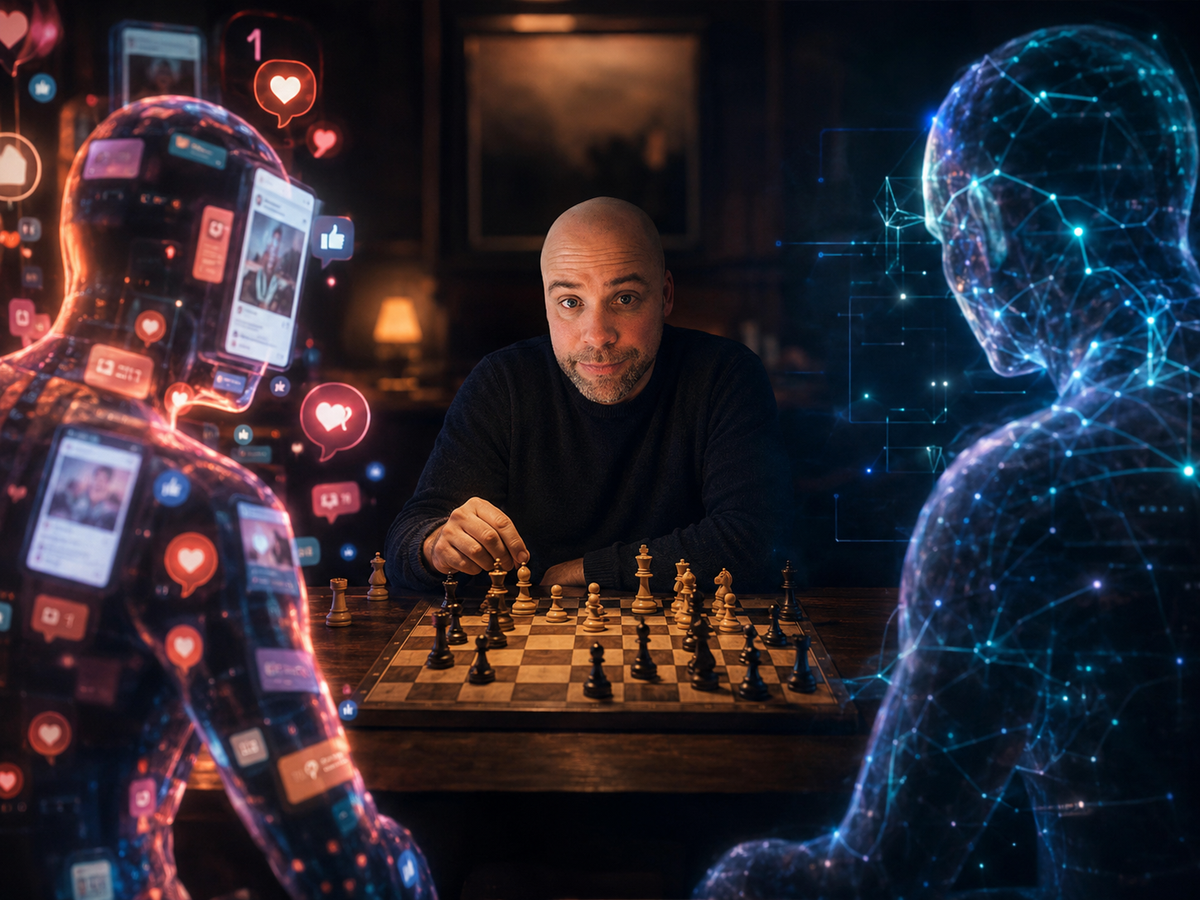
A ban on under-16s, leaky or not, is really just a response to a problem we never fixed at the source, so it is worth asking how social media ever ended up somewhere a coroner would name it as a cause in a child's death. The comfortable answer is that bad people built bad products, but that answer is both wrong and useless, because it lets the next set of builders off the hook and tells us nothing about how to avoid a repeat. The real explanation is structural, and it is a good deal more worrying than a handful of bad actors.
It was the business model, not the people
Social media is mostly free, which means you are not the customer but the product, and your attention is what gets sold to advertisers by the minute. Once that is the model the only number that really matters is engagement, and the content that drives engagement is rarely the calm, balanced, good-for-you sort, because outrage travels further than calm and content that makes a teenage girl feel she is not thin enough travels furthest of all. Nobody sat in a meeting and decided to harm children, but the system was told to maximise attention and it worked out, faster than any person could, that a great many harmful things hold attention beautifully.
Dario Amodei, who runs Anthropic, put this more bluntly than most insiders would in a recent Bloomberg Originals interview, saying that he detests social media as a category and that he deliberately built his company around business tools rather than a consumer app, precisely because an advertising model drags you towards maximising the minutes people spend staring at a screen. His logic was simple enough, that if you pick a business model which fundamentally conflicts with your values then sooner or later you will either betray the values or go out of business, and most social media companies resolved that tension in the obvious direction.
This is the part my engineering background will not let go of, because when the thing you measure drifts away from the thing you actually care about, the system will optimise whatever you measured every single time. The platforms measured minutes watched when what actually mattered was whether a fourteen-year-old was okay, and at the scale of billions of people that gap stops being a rounding error and quietly becomes a generation's mental health.
The harm was always someone else's problem
There is a second mechanism sitting underneath the first, which is that the costs of all this never landed on the companies themselves but on families, schools, the NHS and the children, in the form of eating disorders, anxiety, self-harm content, harassment and the slow erosion of attention and sleep. None of that appears as a line on a balance sheet that counts daily active users and advertising revenue, so an economist would file it under externalities while a parent would simply call it their problem now.
Daniela Amodei, Anthropic's president and Dario's sister, put this well in the same interview, saying that a company does not get to grow its product as fast as it possibly can and then act surprised when it turns out it has helped produce a generation of young women with eating disorders and mental health problems. That is more or less the story of social media, and it happened because the damage never showed up in the numbers the business actually cared about, since daily active users and advertising revenue were measured obsessively while the wellbeing of a fourteen-year-old was not on the dashboard at all, so nobody inside the company was held accountable for it until parents, coroners and journalists forced it into view.
Regulation always arrives after the damage
Even once the harm is undeniable, the response takes years to arrive, and the timeline here makes the point on its own. Molly Russell died in 2017, the inquest that named online content as a cause did not conclude until 2022, the Online Safety Act came after that, and the under-16 ban is only landing now in 2026, which is the best part of a decade between the damage becoming visible and the state doing anything blunt about it, and by the time those rules turned up the platforms had already scaled to billions of users and shaped the habits of an entire generation. This is not really a British failing, it is just the normal shape of things, because technology moves at the speed of code and capital while law moves at the speed of inquiries, consultations and parliamentary time, and the gap between those two speeds is exactly where the harm lives. Reacting after the fact is the only mode we have ever built for ourselves, and it is hopelessly slow against something that can reach hundreds of millions of people in a single year.
The "we didn't know" defence has expired
Early on, the social media companies could at least half-credibly claim that they had not seen it coming, because nobody had run the experiment before, but that excuse has now expired, since we have run the experiment in full, at population scale, on a generation of children, and the results are written up in inquests, in clinics and in a Netflix drama that made the whole country wince. Anyone building the next general-purpose technology now has those findings sitting in front of them before they even start.
That technology is obviously Ai, and it is arriving faster than social media did while reaching deeper into how we work, learn and think, so the question that matters is not whether it will be powerful but whether the people building it have actually absorbed the social media lesson, or whether we will be writing this same article in 2035 with only the names changed. One company keeps insisting, loudly and in public, that it has learned exactly that lesson, and part three is about whether to believe them.